
home : case study
Providence Healthcare / ValueLens Help
Built a Help ecosystem from scratch for a financial analytics platform used across one of the largest healthcare systems in the country, turning a tool that users found frustrating and opaque into one they felt confident navigating independently.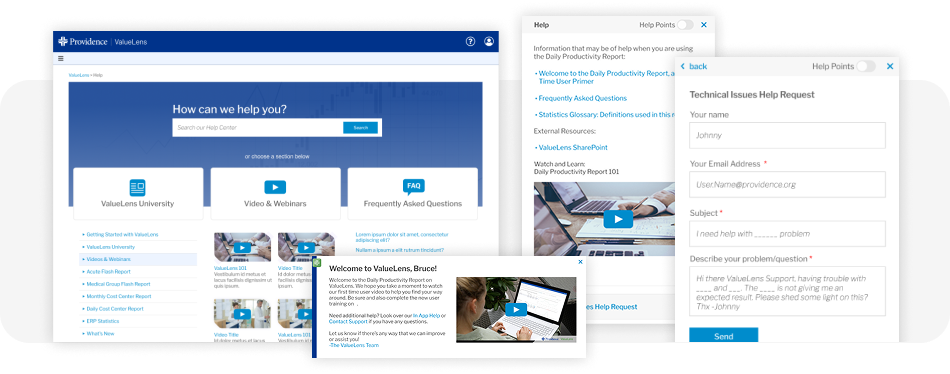
Overview
ValueLens is a financial reporting platform used by healthcare finance professionals across Providence Health. As the platform grew, so did the support burden. Users couldn't find answers on their own, onboarding new cohorts required heavy involvement from product and dev teams, and analysts were spending time being confused instead of doing their jobs.I was brought in to research, design, test, and launch a complete Help ecosystem. The result was a suite of interconnected tools — a searchable Help Center, a context-aware sidebar, inline tooltips, first-time user onboarding modals, a Financial Definitions Library, and a headless CMS — that gave users everything they needed to help themselves.
Impact at a glance:
- NPS scores improved significantly post-launch, moving the product from broadly dissatisfied to satisfied in user perception of available support
- Faster onboarding across user cohorts of thousands at a time, with users reporting they got up to speed more quickly
- Fewer basic support questions routed to product and dev teams, freeing the team to focus on product work
- Non-dev content teams gained the ability to create and publish Help articles instantly, replacing a process that previously required code deployments for every update
The Challenge
Users needed help, but the system couldn’t help them. Interviews revealed several critical issues:- No centralized Help Center or searchable knowledge base
- Help content scattered across PDFs, email threads, external websites, and tribal knowledge
- First-time users struggled to understand core concepts and financial terminology
- Training required heavy support from product + dev teams
- All existing help content required developers to manually update text
My Role
I led the end-to-end UX effort:- User interviews & contextual inquiry
- Competitive + comparative analysis
- Information architecture
- Wireframes & prototypes (Figma)
- Usability testing
- Systems design for Help components
- CMS research and implementation guidance
- Iterative improvements based on user feedback
My Approach
Deep Discovery with Financial AnalystsI interviewed ValueLens power users, financial analysts, and reporting experts to uncover:
- What “help” looks like in tools they enjoy
- Where they get stuck in ValueLens
- Their mental models for financial definitions and calculations
- What they expect during onboarding
Help Center
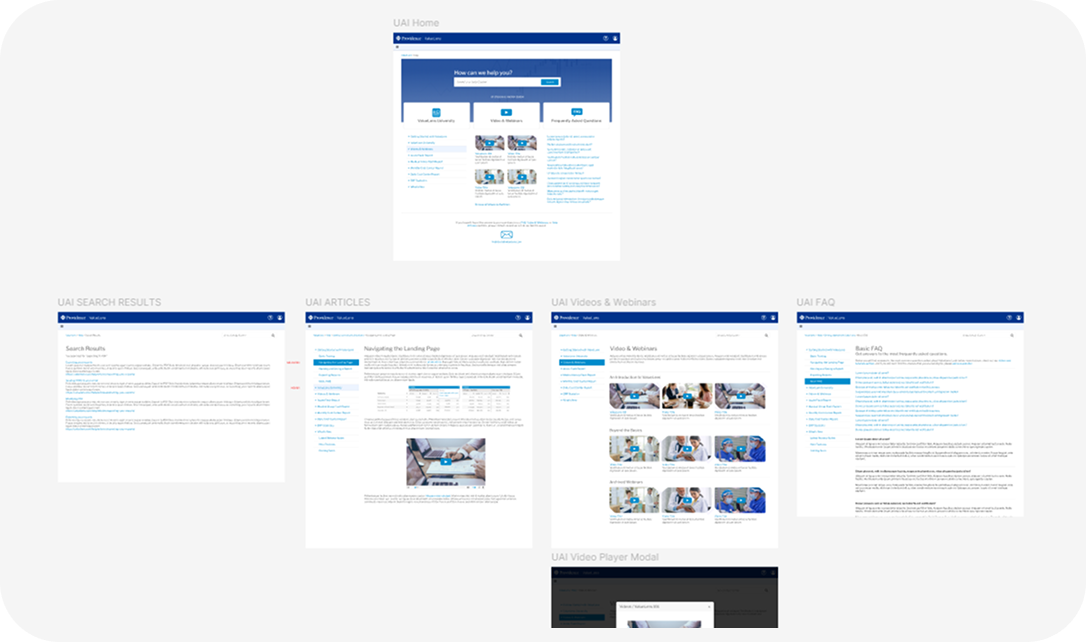
Designed a structured searchable Help Center available from all pages that contained how to guides, report workflows, troubleshooting steps, feature walkthroughs, terminologies, and other helpful videos. Built on an easily accessible content management system that scales easily as the product grows and simple for content managers to add in new content and tag to use areas as needed.
Designed a structured searchable Help Center available from all pages that contained how to guides, report workflows, troubleshooting steps, feature walkthroughs, terminologies, and other helpful videos. Built on an easily accessible content management system that scales easily as the product grows and simple for content managers to add in new content and tag to use areas as needed.
On-Report Help Sidebar
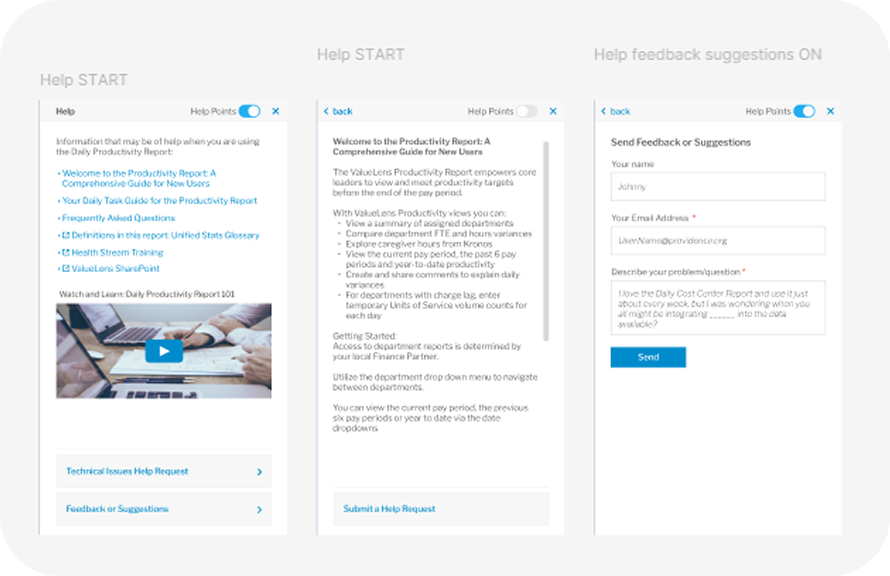
Designed and built a persistent context-aware sidebar that follows users across all reports. The sidebar gave the user the ability to turn on/off overlayed Help content (Help Points), quick access to deep articles specific to the area of the software that the user was currently viewing, and surfaced the ability to submit tickets and feedback directly to the product team.
Help Points (Tooltips)
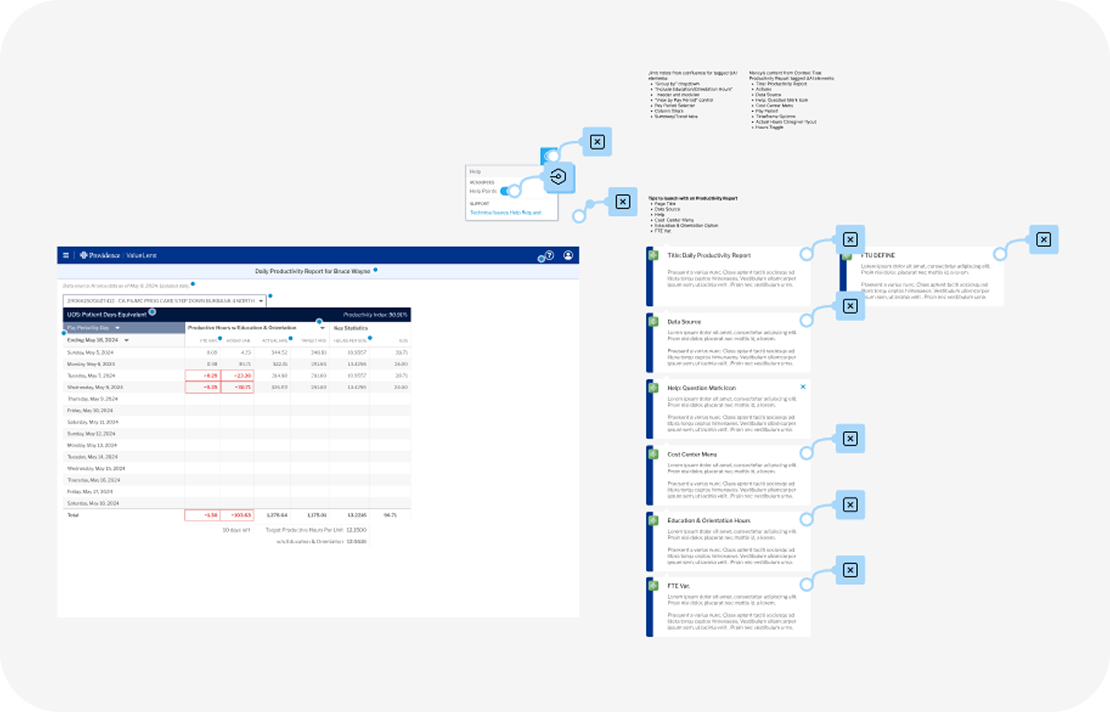
Created an inline micro explanation tool tips feature into the interface named "Help Points". These Help Points explained calculations/filters/metrics and other terminologies specific to the ValueLens platform. They were designed for quick scanning and reducing onboarding time by removing guesswork.
First Time User Experience (FTUE)
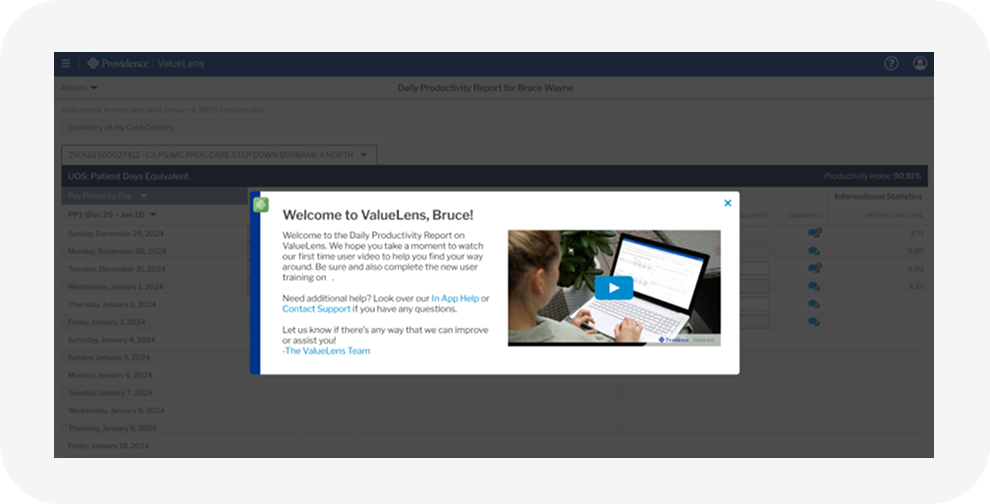
Built a series of new user modals triggered by the first time loading a report on ValueLens. They included welcome information, a video, links to interactive page tours, and other links to helpful information specific to the report loaded by the user. A custom guided onboarding modal aimed to help ease the way of new users as they journeyed into a new data rich reporting tool.
Financial Definitions Library
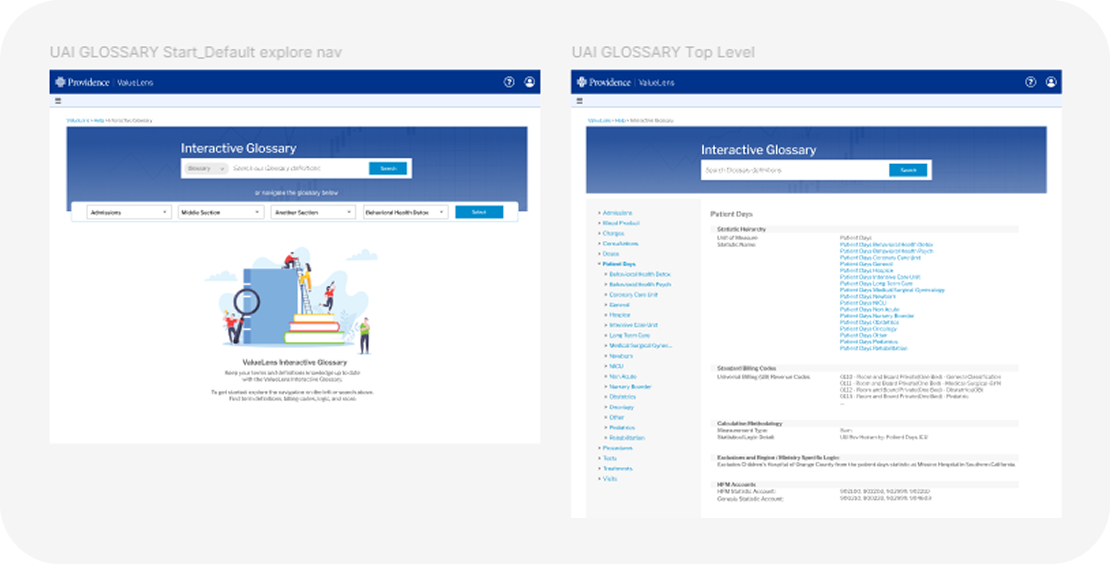
Integrated a library of finance and clinical terminology used in ValueLens directly into the tool. A crucial addition for analysts pulled directly from trusted internal data sources. Replaced static PDF lists that users complained about and was often times difficult for the users to find or they simply did not even know of its existence.
Rapid Content Creation via Headless CMS
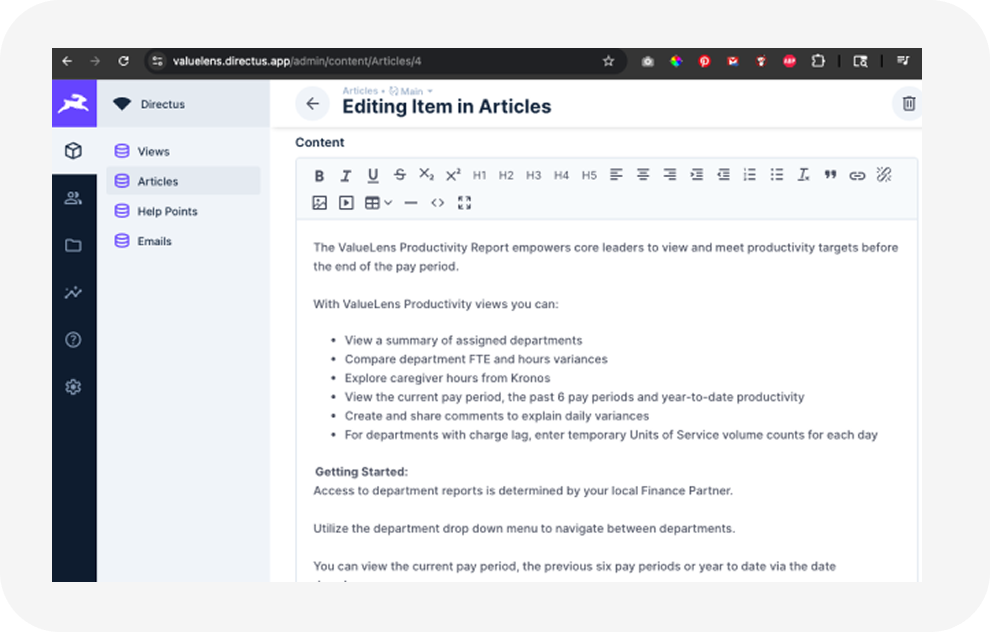
To empower non-technical content creators I evaluated CMS options and led the adoption and integration of a headless CMS solution that was approved via Providence for internal use. This enabled instant real-time editing of content without dev involvement, faster creation of help articles, instant addition of video and audio and other files, as well as version control and content staging. This software addition and integration removed a major bottleneck and saved the dev team dozens of hours per month.
Summary | Impact
The ValueLens Help system became more than documentation. It became a teaching tool, a structured knowledge base, and an onboarding engine that transformed the platform from powerful-but-confusing into something users felt genuinely confident navigating.The architecture I established was built to scale with the product, with a CMS that any content manager could update without touching code, a component system that could extend to new reports and features, and a Help framework that Providence could continue building on long after my work on the project ended.
Lessons learned:
Help is a product, not an afterthought. The most valuable insight from this project was that treating Help as a first-class design problem, with the same research, iteration, and systems thinking applied to the core product, produced results that a bolted-on FAQ page never could have. Users don't struggle because they aren't smart enough. They struggle because the product wasn't designed to teach itself.